What is Achilles tendinitis?
Achilles tendinitis is irritation and inflammation of the Achilles tendon, the strong band of tissue that connects your calf muscles to your heel bone. It helps you walk, run, jump, and push off the ground. When that tendon is asked to do more than it is ready for, it can become painful and stiff.
Many clinicians now use the broader term Achilles tendinopathy because the problem is often more about tendon overload and degeneration than classic inflammation. In everyday language, people still say “Achilles tendinitis,” so we will use that term here.
There are two common patterns:
- Mid-portion Achilles tendinitis – pain in the middle of the tendon, a few centimeters above the heel.
- Insertional Achilles tendinitis – pain where the tendon attaches into the back of the heel bone.
Both respond well to a careful physical therapy plan, but the details of treatment may differ.
Common causes and symptoms
Achilles tendinitis is usually an overuse or overload problem, not a single traumatic event. Some common triggers include:
- Sudden increase in running distance, hills, or speed
- Returning to sport after a break without gradual progression
- Walking more than usual on vacation or for work
- Tight calf muscles or limited ankle mobility
- Hard or uneven training surfaces
- Foot mechanics, such as very high arches or flat feet
Typical symptoms
People with Achilles tendinitis often notice:
- Aching or sharp pain at the back of the heel or lower calf
- Stiffness with the first steps in the morning that improves as you move
- Pain when walking uphill, climbing stairs, or running
- Swelling or a thickened, tender area along the tendon
- Weakness or a feeling of “sluggishness” when pushing off
If you felt or heard a sudden pop in the back of your ankle with immediate weakness and difficulty walking, that can signal a possible Achilles rupture. This is an emergency and needs urgent medical attention.
Do I need imaging or a doctor visit first?
Many cases of Achilles tendinitis can be safely evaluated first by a physical therapist. If we suspect a more serious injury, such as a partial or complete tear, we will refer you to an appropriate medical provider.
You should seek same-day urgent or emergency care if:
- You hear or feel a pop in the Achilles region
- You cannot walk or push off the toes
- The calf or ankle looks deformed
- There is sudden, severe pain and swelling
For more typical, gradually building pain, a physical therapy assessment is a safe and helpful starting point.
How is Achilles tendinitis treated?
Physical therapy as the foundation
Physical therapy is the core treatment for most people with Achilles tendinitis. Rather than simply resting, we help you find the right dose of movement so the tendon can adapt and remodel.
A typical plan at Koda Physical Therapy may include:
- Activity and load management
- Specific strengthening exercises for the calf and foot
- Flexibility and mobility work
- Balance and control training
- Education about pain, pacing, and long-term prevention
- Recommend Regenerative therapies like EMTT and shockwave to support tendon healing
Load management and activity modification
Completely stopping all activity is rarely the best answer. Instead, we usually recommend modifying your activities while keeping you as active as safely possible.
This might include:
- Reducing running distance, hills, or speed
- Switching temporarily to lower-impact activities like cycling or swimming (if comfortable)
- Avoiding repeated stair climbing or heavy jumping early on
- Using pain as a guide – mild discomfort during or after activity is often acceptable, but strong or worsening pain is a sign to back off
Your physical therapist will help you find a pain range that is tolerable and safe for healing.
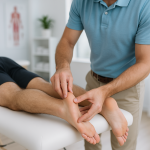
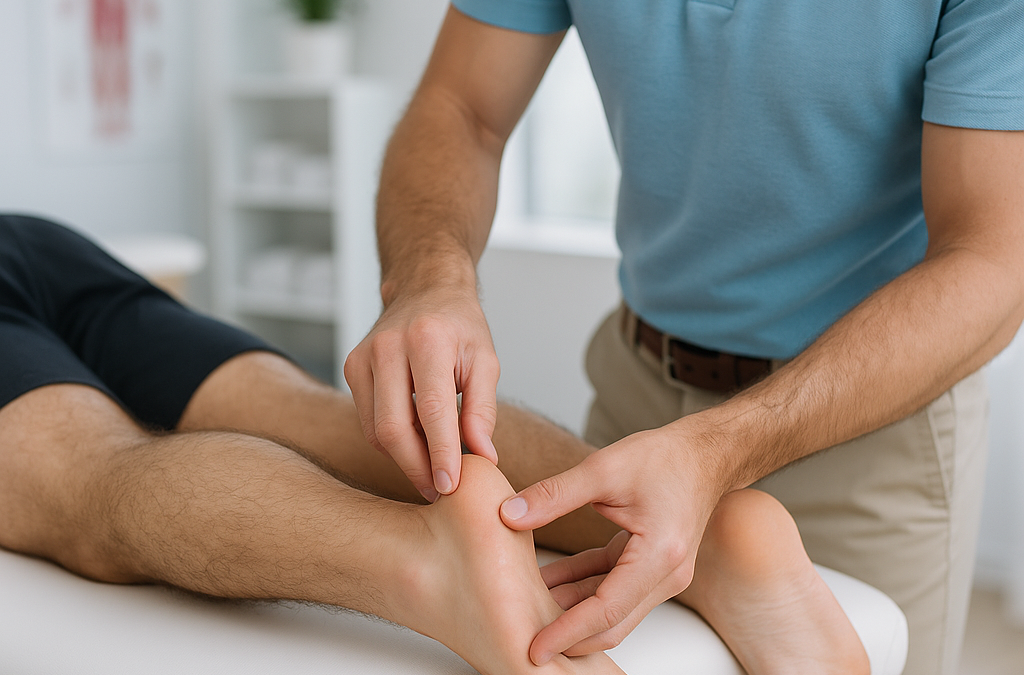
Hands-on care can help reduce protective muscle tension and improve flexibility.
Manual therapy and mobility work
How the ankle and foot move. Depending on your exam, your therapist may use:
- Soft tissue techniques around the calf and Achilles
- Gentle joint mobilizations for the ankle and foot
- Guided stretching to improve calf and ankle flexibility
These techniques are not a cure by themselves but can make it easier to perform your exercises effectively.
Technology at Koda Physical Therapy: EMTT and shockwave
At Koda Physical Therapy, we integrate advanced technologies where they are appropriate and evidence based. Two tools that may be used alongside exercise for Achilles tendinitis are EMTT and shockwave therapy.
EMTT (Extracorporeal Magnetotransduction Therapy)
EMTT uses high-energy magnetic fields applied from outside the body. The goal is to influence cellular activity in tissues such as tendons and ligaments. Current research is still developing, but EMTT is being studied for chronic tendon and joint problems.
EMTT devices we use are CE-marked medical devices, meaning they meet European health, safety, and performance standards. In physical therapy, EMTT is typically combined with a structured exercise program rather than used alone.
Possible benefits may include:
- Supporting local circulation to reduce inflammation
- Modulating pain
- Restoring cellular health to promote natural tissue repair processes
Shockwave therapy (Extracorporeal Shock Wave Therapy, ESWT)
Shockwave therapy uses controlled acoustic waves delivered to the painful area. For chronic Achilles tendinitis that has not improved with basic care, studies suggest shockwave can help reduce pain and support function when combined with exercise.
The shockwave devices we use are also CE-marked medical devices. Sessions are usually brief and may feel uncomfortable but are generally well tolerated.
It is important to understand:
- Shockwave is not an instant cure. One must consider tissue healing as a process.
- It works best as part of a comprehensive physical therapy plan
- A series of at least 6 sessions is recommended over a 6 week period
- Tissue healing will continue for the next 6-12 weeks following the final session
Your physical therapist will review whether EMTT, shockwave, or both may fit your situation based on your exam, goals, and medical history.
Can I do anything to speed the healing process?
There are several things you can do to support more efficient healing.
1. Respect pain signals
Mild soreness in the tendon during or after activity is common and can be acceptable. Sharp, worsening, or lingering pain that increases day by day is a sign to reduce load. Using a simple 0 to 10 scale, we often aim for pain no higher than 3 to 4 during rehab exercises, settling back to your usual level within 24 hours.
2. Be consistent with exercises
Tendons respond best to regular, progressive loading. Doing the right exercises a few times per week is far more effective than doing a large amount only occasionally. Your therapist will help you find the right starting level and how to progress.
3. Avoid complete rest for too long
Short-term rest from aggravating activities can calm pain, but long-term inactivity can weaken the tendon and muscle. The goal is to keep you moving within safe limits so the tendon can remodel and grow stronger.
4. Regenerative therapies (EMTT and Shockwave)
These therapies put your body and tissues in the best possible environment to heal by resetting the cells and triggering the body’s natural healing response. With an 80% success rate, utilizing these two therapies in conjunction with guided physical therapy exercises will give one the best chance of returning to their desired activities quickly.
5. Support recovery outside the clinic
Your body heals between sessions, not just during them. Helpful habits include:
- Prioritizing quality sleep
- Spacing out higher-load days instead of stacking them back to back
- Warming up before heavier activities
If you are considering medications or supplements, discuss them with your medical provider to ensure they are safe for you.
3 exercises that can help Achilles tendinitis
These exercises are general examples often used in rehab for Achilles tendinitis. They may not be right for everyone. Stop if pain is sharp, worsening, or does not settle by the next day, and check with a physical therapist for an individualized plan.
1. Standing calf stretch (gastrocnemius focus)
Goal: Improve flexibility of the upper calf and reduce morning or start-up stiffness.
How to do it:
- Stand facing a wall with your hands on the wall for balance.
- Put the painful side behind you with the knee straight and heel flat on the floor.
- Gently lean your body forward until you feel a stretch in the upper calf.
- Hold for 20 to 30 seconds, then relax.
Repetitions: 3 to 5 holds, 1 to 2 times per day, as comfortable.
Keep the stretch mild to moderate, not painful.
2. Bent-knee calf stretch (soleus focus)
Goal: Target the deeper soleus muscle, which plays a big role in walking and running.
How to do it:
- Use the same wall position as the first stretch.
- Slide the back foot slightly closer and bend both knees while keeping both heels on the floor.
- You should feel the stretch lower in the calf closer to the Achilles.
- Hold for 20 to 30 seconds, then relax.
Repetitions: 3 to 5 holds, 1 to 2 times per day, as tolerated.
3. Eccentric heel drops on a step
This is one of the most studied exercises for chronic Achilles tendinopathy. It focuses on the “lowering” phase, which helps the tendon adapt to load.
Important: This exercise can be too aggressive in the very early, painful stages. It is usually introduced when day-to-day pain is more stable. Check with your therapist before starting.
How to do it:
- Stand on a step or sturdy platform, holding a railing or counter for balance.
- Start with both feet on the step, heels just off the edge.
- Rise up onto your toes using both legs.
- Shift your weight onto the painful leg.
- Slowly lower that heel down below the level of the step over about 3 seconds.
- Place the other foot back down and use both legs to help return to the starting position.
You can begin with the knee straight and, later in rehab, repeat with a slight bend in the knee to target the soleus.
Repetitions: Often 2 to 3 sets of 8 to 12 slow lowers, 1 to 2 times per day, but this should be customized to your pain and strength level.
If you notice a big increase in pain or limping after this exercise, reduce the range of motion, decrease the number of repetitions, or pause and talk with your therapist.
When should I seek help for Achilles tendinitis?
You should consider a professional physical therapy assessment if:
- Pain has lasted more than 2 to 3 weeks
- Morning stiffness is not improving
- You are starting to avoid activities you enjoy
- Self-care and basic stretching are not making a difference
Early guidance can shorten the time you spend guessing what to do and help you avoid setbacks.
How Koda Physical Therapy approaches Achilles tendinitis
At Koda Physical Therapy, we combine advanced science with practical, real-world movement. Our approach to Achilles tendinitis typically includes:
- A detailed history and movement assessment
- Evaluation of calf and foot strength, tendon tolerance, and running or walking mechanics when relevant
- A phased loading program tailored to your pain level and goals
- Manual therapy and mobility work as needed
- Education on pacing, footwear considerations, and long-term tendon health
- When appropriate, integration of CE-marked EMTT and shockwave technologies to support tendon healing and pain modulation
The goal is not just to reduce pain but to help you understand why the problem developed and how to prevent it from returning.
Bottom line: Move smarter, recover stronger
Achilles tendinitis can be frustrating, especially if it lingers or keeps you from the activities you love. The good news is that most people improve with a structured physical therapy plan that uses the right exercises, smart load management, and, when indicated, supportive technologies like EMTT and shockwave therapy.
You do not have to figure it out alone. A targeted assessment and personalized plan can help you understand your pain, reclaim your movement, and get back to walking, running, and living with confidence.
Important disclaimer
The information in this article is for educational purposes only and is not a substitute for professional medical advice, diagnosis, or treatment. Always seek the advice of your physician, physical therapist, or other qualified health provider with any questions you may have regarding a medical condition.
References
0
Title: Achilles tendinitis – Symptoms and causes
Url: https://www.mayoclinic.org/diseases-conditions/achilles-tendinitis/symptoms-causes/syc-20369020
Source Type: website
Year: 2023
Note: General overview of Achilles tendinitis, risk factors, and symptoms.
Formatted Citation: Mayo Clinic Staff. Achilles tendinitis – Symptoms and causes. Mayo Clinic. 2023.
1
Title: Achilles Tendinitis
Url: https://orthoinfo.aaos.org/en/diseases–conditions/achilles-tendinitis/
Source Type: website
Year: 2022
Note: Patient-focused summary of Achilles tendinitis and treatment options.
Formatted Citation: American Academy of Orthopaedic Surgeons. Achilles Tendinitis. OrthoInfo. 2022.
2
Title: Treatment of chronic Achilles tendinosis with eccentric calf-muscle training
Url: https://pubmed.ncbi.nlm.nih.gov/9425833/
Source Type: journal
Year: 1998
Note: Classic study supporting eccentric calf training for chronic Achilles tendinosis.
Formatted Citation: Alfredson H, Pietila T, Jonsson P, Lorentzon R. Treatment of chronic Achilles tendinosis with eccentric calf-muscle training. Am J Sports Med. 1998;26(3):360-366.