
A Healthy Rotator Cuff = a Healthy Shoulder
Everyone has probably heard about The Rotator Cuff, but few people understand how it actually works. It’s a very crucial yet vulnerable part of your shoulder. A tear of the rotator cuff is very common in sports where there are a lot of overhead motions like baseball and tennis. But even more common are tears from repetitive use while lifting, pushing, and pulling. So whether you’re a baseball pitcher, or you’re a janitor, you may be at risk. Before we talk about how to prevent or treat rotator cuff injuries, let’s go over the anatomy of the shoulder.
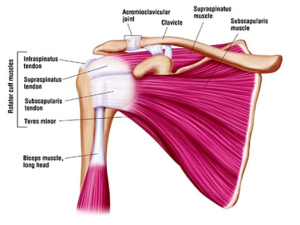
The shoulder is a ball and socket joint, but unlike the hip that has a deep socket, the shoulder socket, or glenoid cavity, is very shallow. So that makes the shoulder the most mobile joint in the entire human body. Unfortunately, with that mobility comes a lack of stability and it is one of the most frequently injured joints. The Rotator Cuff is composed of a set of 4 muscles that live on the scapula and all converge onto the head of the humerus bone. These tendons hold the ball into the socket as well as rotate the arm around. They have a very crucial function as deep stabilizers, yet they are relatively small muscles and their tendons are very vulnerable to being pinched and frayed over time.
Now, you may think that if you just go to the gym and do the bench press or lat pulldown machines that you’ll get in great shape and have a strong rotator cuff. Unfortunately, you may be doing more harm than good with traditional gym exercises, and we see plenty of people with rotator cuff tears just from working out too hard. In Physical Therapy, we talk about strengthening in a very specific sequence, usually starting with the deep and small muscles, then moving outward to the superficial, large muscles. In the shoulder we break it down further into 3 groups:
- Stabilizers: The 4 rotator cuff muscles provide precise rotational control and deep stability
- Supraspinatus
- Infraspinatus
- Subscapularis
- Teres Major
- Positioners: The scapular stabilizers get the scapula where the socket is in the best angle for movement to occur
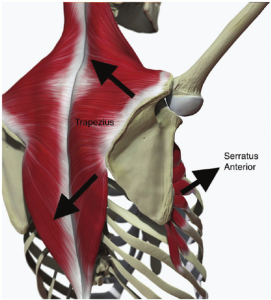
- Upper, middle, and lower trapezius
- Serratus Anterior
- Rhomboids
- Movers: The large muscles that actually move the arm in various directions
- Deltoids
- Pecs
- Lats
Just like building a foundation before you put the walls and roof on a house, you’ve got to strengthen your rotator cuff first. Once you’ve got some good baseline rotator cuff strength, you can add in exercises for the scapular stabilizers. And finally, only then should you get into the classic gym exercises that target the large “pretty” muscles that most people obsess over like pecs. And all the while you’ve got to keep a good balance between the chest muscles and back muscles. For some people whose chest muscles are overdeveloped, they have to stop strengthening the chest completely. They would focus on only stretching the chest and strengthening the back for a few months.
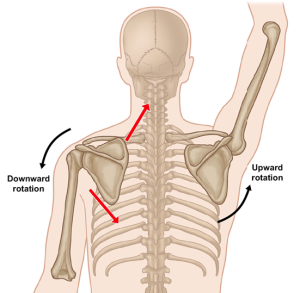
So we’re going to show you a few rotator cuff strengthening exercises to get started with since they are relatively easy to understand. After doing these, you’ll move on to exercises directed towards the scapular stabilizers. It’s important to get the scapula rotating upward when doing exercises overhead to reduce the pinching of the rotator cuff tendons. The lower trapezius and serratus anterior work together to accomplish this. It becomes a bit more complicated to get the technique correct on this second category of shoulder exercises, so we recommend coming in for a few sessions of physical therapy to ensure that you’re getting it right.
- External Rotation With Resistance Band
- Begin standing upright with your elbow bent at 90 degrees and a towel roll tucked under your arm, holding a resistance band that is anchored out to your opposite side.
- Rotate your arm out to your side, pulling against the resistance, then slowly return to the starting position and repeat.
- Make sure to keep your hips and shoulders facing forward and don’t allow your trunk to rotate. Do not shrug your shoulders during the exercise.
- Shoulder Internal Rotation with Resistance Band
- Begin in a standing upright position with your elbow bent at 90 degrees and a towel roll tucked under your arm, holding a resistance band. The anchor point should be on the side closest to your bent arm.
- Slowly rotate your arm inward, then slowly return to the starting position and repeat
- Make sure to keep your hips and shoulders facing forward and don’t allow your trunk to rotate.